Charlie Finley: A Handwritten Script Font That Feels Like Home
I was halfway through designing a new batch of soy candle labels—amber glass jars, linen tags, soft kraft paper sleeves—when I paused. The clean sans serif I’d been using felt precise, yes, but somehow distant. What these candles needed wasn’t just clarity—it was warmth. A quiet confidence. A little breath of personality that said “hand-poured,” “thoughtfully made,” and “made for moments.” That’s when I opened Charlie Finley.
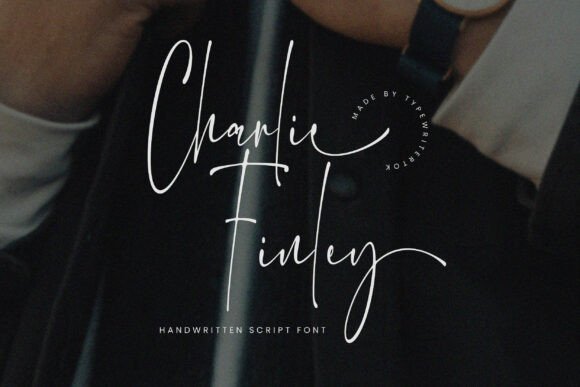
Right away, I knew it was the one. Charlie Finley is a handwritten script font from Script Amp, crafted with intention—not as a flashy flourish, but as an authentic voice. Its strokes flow like ink pulled gently across paper: slightly varied in weight, softly tapered, with natural entry and exit strokes that never feel forced. There’s no stiff perfection here—just graceful rhythm, subtle contrast, and a warmth that reads as both modern and timeless. It’s the kind of script font that doesn’t shout; it leans in and speaks quietly, confidently.
I started small: testing “Lavender & Rain” on a 2-inch round sticker for a seasonal candle. Printed on matte white vinyl, Charlie Finley held up beautifully—even at that scale. The letterforms stayed legible without losing their character. No pixelation, no awkward gaps between letters. For Cricut and Silhouette users, that matters: Charlie Finley is cleanly digitized, with well-spaced glyphs and consistent kerning. When cutting vinyl or printing tiny boutique tags, you’ll appreciate how smoothly the curves translate from screen to material.
Then came the greeting cards. I used Charlie Finley for the sentiment on a set of hand-folded notecards—“You Make Every Day Brighter”—paired with a light, airy sans serif (like Poppins Light) for the sender line. The pairing worked instantly: Charlie Finley carried the emotional weight, while the sans serif grounded it with calm balance. That’s the magic of thoughtful font pairing. As a display font, Charlie Finley shines brightest in short phrases—names, titles, quotes, product names—but avoid long paragraphs. Its charm lives in intentionality, not endurance.
For wedding stationery, Charlie Finley adds instant elegance without formality. I designed a welcome board for a backyard ceremony using “Welcome to Our Love Story” in Charlie Finley, then layered it over a simple serif (like Playfair Display) for the date and location. The contrast elevated everything—soft yet structured, personal yet polished. It’s equally at home on digital downloads: printable wall art with botanical line drawings, planner cover pages with gentle affirmations, or even a minimalist tote bag design where “Good Things Take Time” curves just so across the front.
Seasonal work is where Charlie Finley really sings. Last December, I used it for holiday gift tags—“For You, With Love” in deep forest green ink on cream cardstock. The script’s natural variation gave each tag a handmade feel, even though they were all printed from the same file. And because Charlie Finley includes standard ligatures and stylistic alternates (like a swashed capital “C” or a flowing “&”), I could easily swap in a more decorative version for packaging headers or shop banners—without needing a separate font file.
When it comes to physical merchandise—mugs, shirts, tea towels—I always test readability first. Charlie Finley works beautifully on ceramic mugs (especially with a crisp white glaze), but I avoid using it smaller than 14pt on fabric unless it’s a large chest print. On black t-shirts, I sometimes add a subtle white stroke to ensure contrast. For packaging design, I often use Charlie Finley only for the brand name or flavor name, then switch to a clean sans serif for ingredients or care instructions. That hierarchy keeps things scannable—and trustworthy.
One thing I always check before launching any product: licensing. Charlie Finley is a commercial font, meaning it’s cleared for use in physical goods, digital templates, SVG files, and printables sold on Etsy or your own site—as long as you’ve purchased the full license. It supports Latin-based languages and includes OpenType features like contextual alternates and discretionary ligatures, which help avoid repetitive-looking letter combinations. File formats typically include OTF and TTF, so it’s compatible with Canva, Adobe Creative Cloud, Cricut Design Space, and Silhouette Studio.
What makes Charlie Finley different from other script fonts? It’s not about being the most ornate or the flashiest—it’s about being *true*. True to the handmade spirit. True to the quiet pride of making something real. When customers see Charlie Finley on a candle label, they don’t just read the scent name—they sense care. When it appears on a wedding invitation, it doesn’t just say “RSVP”—it says “this moment matters.” That emotional resonance is hard to replicate, and rarer still to find in a single typeface.
I’ve used Charlie Finley on farmhouse-style signs (“Gather Here”), digital sticker sheets (with playful “hello friend” captions), boutique packaging ribbons, printable baby shower games, and even the header for my shop’s seasonal newsletter. Each time, it feels like adding a familiar, trusted voice—not just typography, but tone.
If you’re choosing a script font for your next product launch, ask yourself: Does it reflect the feeling you want people to carry away? Does it hold up on a tiny sticker *and* a bold wall print? Does it pair effortlessly with something clean and grounded? Charlie Finley does all three—and leaves room for your creativity to breathe.
It’s more than a font. It’s the quiet signature on something made with hands, heart, and attention.